

Welcome to our newsletter, dear reader,
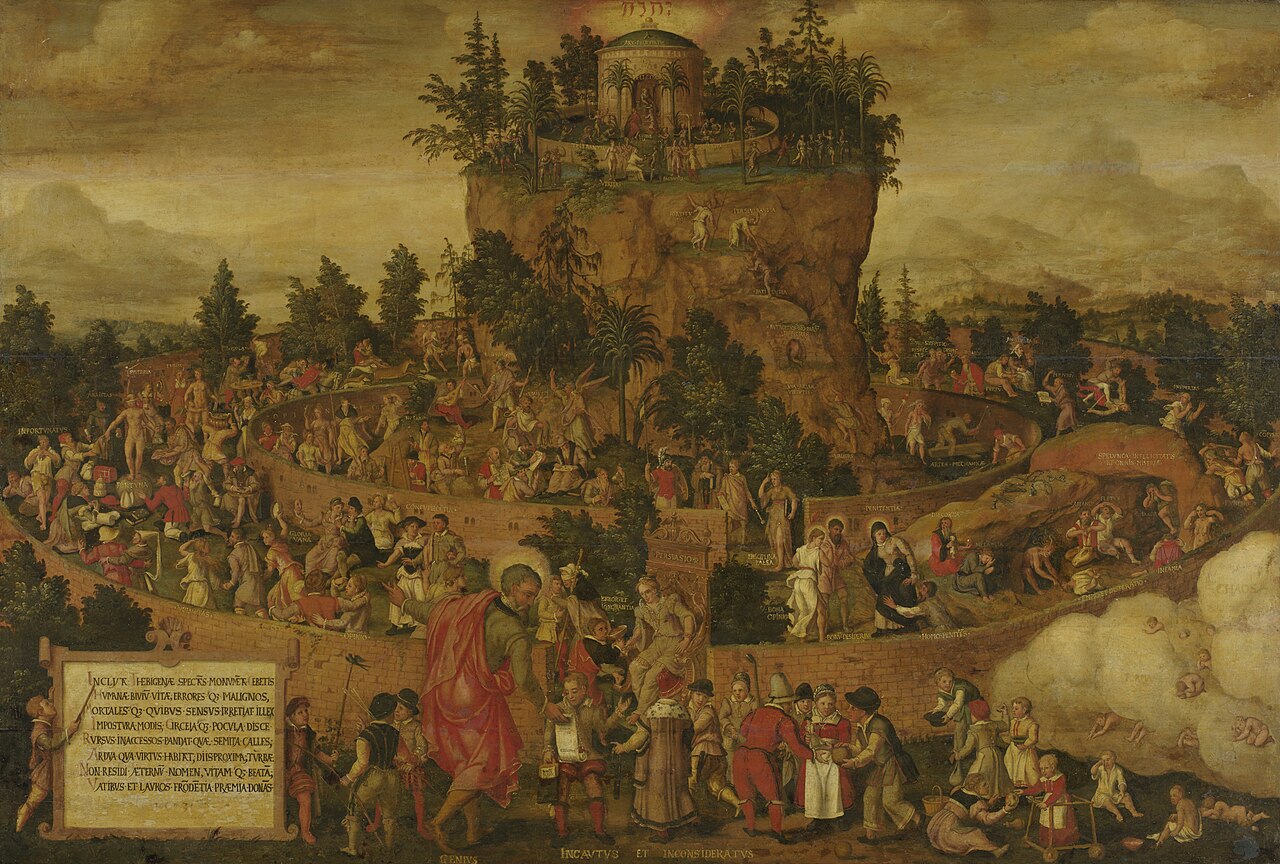
• Our first new library item is the famous “Picture of Cebes”, a simple and engaging narrative based on the description of an allegorical wall painting. This “Picture” is an influential account of the initiatic development of the soul towards salvation by means of moral cultivation. We give direct access and links to a translation, and to several editions of the original Greek, Latin and Arabic texts.
‘Do not be astonished, my friends, that you find yourselves baffled by this painting, for even many of those native to this place do not know the meaning of the story. It was not dedicated to the temple by a local citizen, but by a stranger who came here long ago, someone of understanding and great wisdom, who emulated in words and deeds the Pythagorean and Parmenidean way of life. It was he who dedicated both this temple and the painting to Cronus.’
Anonymous, Tabula_Cebetis, Rijksmuseum. Image from Wikimedia Commons.
• We continue with “The Elements of True Piety”, from the shorter writings of G.W. Leibniz, where the famous mathematician and philosopher introduces his reasoning for a radical and pious optimism, based on subtle metaphysical arguments about the nature of God. “Anyone is able to live rightly merely on account of human causes, such as education, custom, public peace, personal safety, and good repute. However we are concerned here with those things that we do or endure because of God.”
Given the most perfect being, namely God (as I now suppose), that the most perfect operation is that of the most perfect being, and that the world is the work of God, then the world is the most perfect, and hence no other series of things can be imagined which is more perfect than this one.
Alternatively: things have as much possibility as they have reality (for the essence of a rose in winter is the same thing as its possibility of existence) therefore those things that have the most possibility are without doubt those that exist in actuality, since they have the most reality, i.e. according to the definition of perfection they are the most perfect.
• Finally, in line with Leibniz, we present “The Perfect Rightness of the Actual”, a chapter from Eric Ormsby’s erudite Theodicy in Islamic Thought. In these demanding and very rewarding pages, we are introduced to the dispute over al-Ghazali’s teaching on the best of all possible worlds, and its parallels inside and outside the Islamic tradition.
The aspirant to tawakkul (trust) must crave not lordship, however, but to be “like an infant who knows no refuge other than his mother’s breast.” Or, as another famous saying has it, he must be “in God’s hands like a corpse in the corpse-washer’s hands, who turns him however he wishes…”. But it is not enough to be Kadavergehorsam; the aspirant must achieve a changed perception of the world, and this entails more than mere “resignation to the course of fate’s decrees,” even if this is a prerequisite. What is ultimately required is a “good opinion of God,” leading to complete faith in the divine mercy and wisdom.