
Welcome to our newsletter, dear reader,
• Our first library novelty this month is the introductory section to Women in Sufism, an extraordinary anthology by Camille Adams Helminski, from the earliest times of the Hijra to our days.
As Muhammad said, “He who knows himself knows his Lord.” It is love that carries and sustains us through this process. The door of Sufism will finally open only with Love, because—though knowledge may be important and can assist in our discrimination along the way and may help us to reach the threshold—it is ultimately through Love that we are brought into unity of Being. Throughout the centuries, women as well as men have continued to carry the Light of this Love. For many reasons, in many places, the women have been less visible than the men, less verbal, less demonstrative in society at large, but nevertheless active participants.
• Next we have an article on the duality of the seal/mudra, written or stamped lines and gestures of the hand which form essential part of rites in many traditions. In their conceptual and ritual unity the “seals made with the hands” bespeak the underlying order of reality, and invite human participation, age after age, as in in early India, where “a sign language of the hands was considered an art or accomplishment with which an educated person should be familiar.”
Indic, or Indic-inspired, mudras, or “seals”, made with the hands, replaced Chinese stamp seals in most Buddhist rituals—as well as in many rites of the Daoist religion from around the year 1000 CE onwards. On the more purely conceptual side here, too, Indic Buddhist metaphors of “Buddha Seals” profoundly shaped Chinese understandings of the nature of reality.
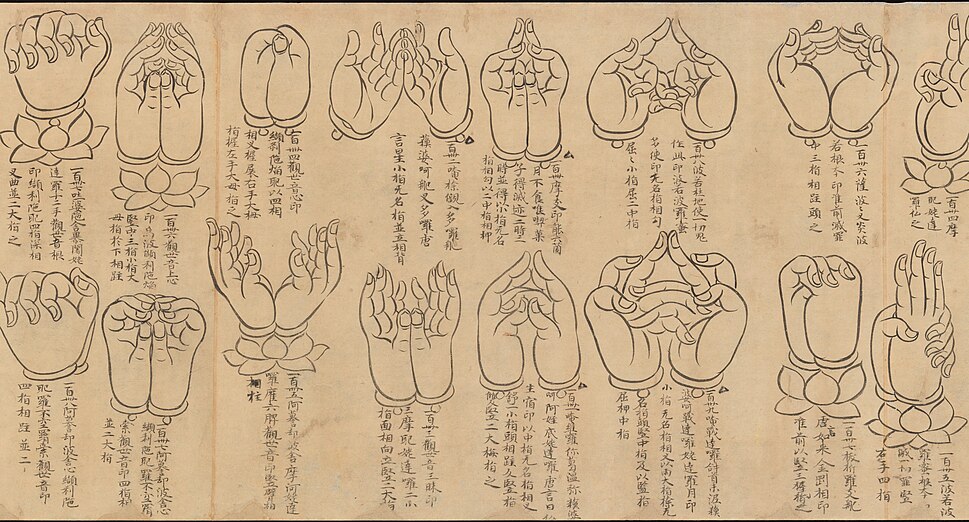
• We conclude with some pages by Ananda K. Coomaraswamy where the symbolism of mudras appears in relation to the images of Buddha and Siva.
Siva is thus one with that Eros Protogonos, Lord of Life and Death, of whom Lucian spoke when he said, “It would seem that dancing came into being at the beginning of all things, and was brought to light together with Eros, that ancient one for we see this primeval dancing clearly set forth in the choral dance of the constellations, and in the planets and fixed stars, their interweaving and interchange and orderly harmony.” Of concrete symbols associated with the dancing figure… the hand upraised (in abhaya mudra) says to the worshipper, Fear not.